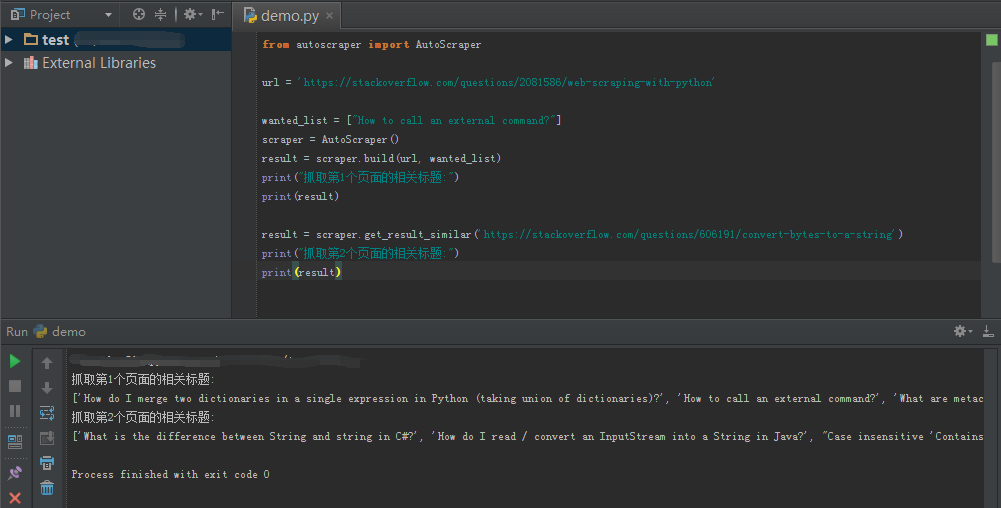
简介 9 M" G" A7 F& Q0 R) a- ^2 Q0 o AutoScraper 是使用 Python 实现的 Web 爬虫,兼容 Python 3,能快速且智能获取指定网站上的数据,这些数据可以是网页文本、URL 地址或者是其它 HTML 元素。另外,它还可以学习抓取规则并返回类似的元素。0 J& U( Y3 ]' J/ D: t$ s. j* p 下载安装 2 {1 G& q' p8 g: X% ]0 \: x4 l https://github.com/alirezamika/autoscraper / B* ^/ r; a: [: f9 A 9 i& _: x% G( {8 q( h https://github.com/alirezamika/autoscraper.git 5 w$ L! z' g; U) H' o/ k 6 n! u0 x0 ^6 p( O4 C1 c; f! Y/ E; R4 \7 ~ (3)下载源码后进行安装 $ python setup.py install4 l! B7 t/ h3 d* a9 H Y6 D 简单使用 ( A7 Q l: T- m0 l# z2 k6 O 假设我们想在stackoverflow页面中获取所有相关的文章标题:. ^# ]5 }( r# `/ ? from autoscraper import AutoScraper
url = 'https://stackoverflow.com/questions/2081586/web-scraping-with-python'
wanted_list = ["How to call an external command?"]
scraper = AutoScraper()
result = scraper.build(url, wanted_list)
print(result)6 ]0 S+ T# B0 r* D0 K, f [
'How do I merge two dictionaries in a single expression in Python (taking union of dictionaries)?',
'How to call an external command?',
'What are metaclasses in Python?',
'Does Python have a ternary conditional operator?',
'How do you remove duplicates from a list whilst preserving order?',
'Convert bytes to a string',
'How to get line count of a large file cheaply in Python?',
"Does Python have a string 'contains' substring method?",
'Why is “1000000000000000 in range(1000000000000001)” so fast in Python 3?'
]抓取相似结果 $ o' M: k" a0 p q' W' q# R f5 ?! t; [& ]3 S0 e3 t scraper.get_result_similar('https://stackoverflow.com/questions/606191/convert-bytes-to-a-string')7 U# ?. r9 \& `
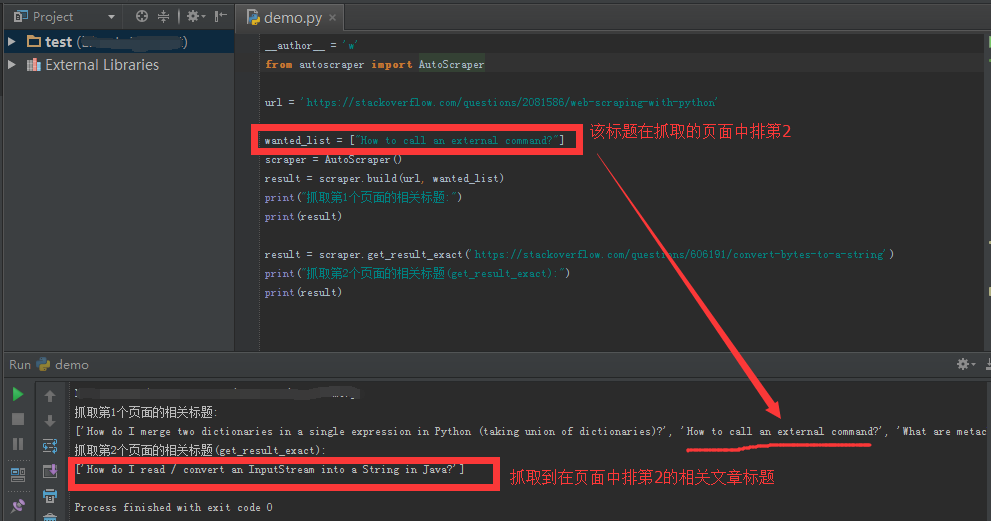
5 J# ^) ~9 F9 I6 n 抓取确切结果 ; [& m2 R1 A& U6 x* T * P) n2 w) X& d5 c scraper.get_result_exact('https://stackoverflow.com/questions/606191/convert-bytes-to-a-string'); E+ \$ J1 A" _+ i" E
+ b: [! l9 O) b7 f: P 自定义请求模块参数 : u- \) k/ g" u1 w3 e J) ~, r 你还可以传递任何自定义请求模块参数。例如,你可能想使用代理或自定义头:4 D+ U6 _1 `( c proxies = {
"http": 'http://127.0.0.1:8001',
"https": 'https://127.0.0.1:8001',
}
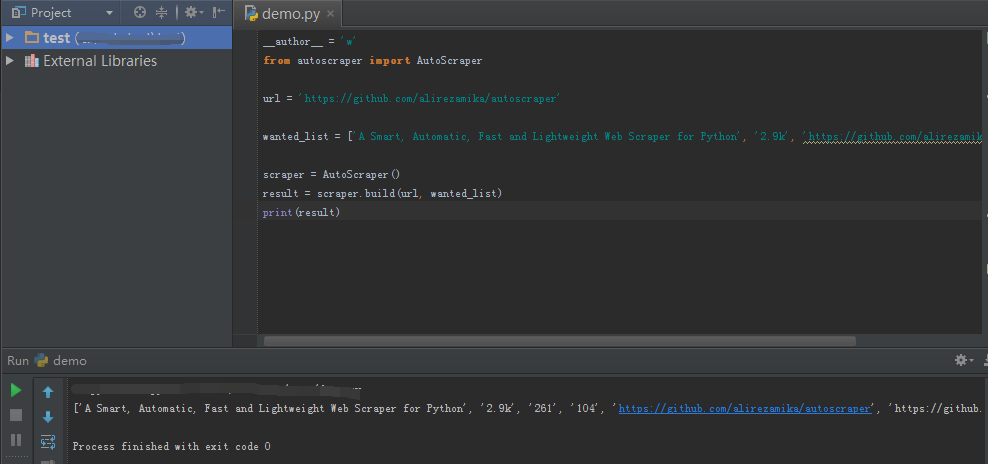
result = scraper.build(url, wanted_list, request_args=dict(proxies=proxies))抓取多项信息 % [, ?/ ]7 S1 w: h* ~8 {& G% F/ v 假设我们想要抓取关于文本,Star的数量和Github回购页面的问题链接:7 i4 i3 r7 Y! i* {, K" k from autoscraper import AutoScraper
url = 'https://github.com/alirezamika/autoscraper'
wanted_list = ['A Smart, Automatic, Fast and Lightweight Web Scraper for Python', '2.5k', 'https://github.com/alirezamika/autoscraper/issues']
scraper = AutoScraper()
scraper.build(url, wanted_list)! r( c5 w2 l$ j0 ?
3 m& g, z& z4 U5 W8 m, L" j" T 保存模型 " h' X, \* V6 L+ |4 X* c/ \: { 我们可以保存抓取的模型以便以后使用:2 w7 q p2 Y- `4 M& x # 指定保存的文件路径
scraper.save('stackoverflow')
# 调用方法:
scraper.load('stackoverflow')0 T y: G8 O( v% V5 |0 | 6 W* L8 {6 P7 d7 m' O5 Q" p  |手机版|小黑屋|paopaomj.COM
(
|手机版|小黑屋|paopaomj.COM
(  渝ICP备18007172号|
 渝公网安备50010502503914号 )



 发表于 2021-1-11 13:34:43